In the data age, growth becomes possible not so much through the statistics we can see, but through the courage to measure what we can’t. Understanding the "why" behind the data means going beyond report lines and dashboard charts to grasp the intent behind a behavior and the emotion behind the numbers.
The aim of this article is to prove how this philosophy works in practice. Drawing on Human-in-the-Loop AI applications, current industry reports and real-world case studies, we will show how this approach delivers tangible growth results.
What Is The Intelligence Layer?
We see The Intelligence Layer as a brand’s thinking system. Design represents the emotional side and strategy the managerial side; the Intelligence Layer is the consciousness that feeds them both. This is where data, artificial intelligence and human intuition work together toward the same goal.
Making sense of data rather than just collecting it: What matters today is not how much data we collect, but how much meaning we can extract from it. Figuring out why a user abandons a form halfway, why they revisit a piece of content, or why they react strongly to a particular word requires focusing on context rather than numbers. By bringing together signals such as intent data, CRM records, search trends and content consumption, we try to understand what users do and why they do it.
AI is a support layer: Artificial intelligence is an assistant that speeds up our thinking. It accelerates time-consuming processes such as data cleansing, segment matching and content analysis, freeing up space for strategic decisions. But it is still people who give these outputs meaning and turn them into strategy.
The balance between data and intuition: Data tells us what is happening; intuition reveals why. A spike in a campaign doesn’t always mean success; sometimes it can be the result of a behavioral error. Spotting that difference is an insight that only develops with experience. That’s why at Pikap we don’t settle for simply measuring data, we also write its story.
Human-in-the-Loop (HITL)
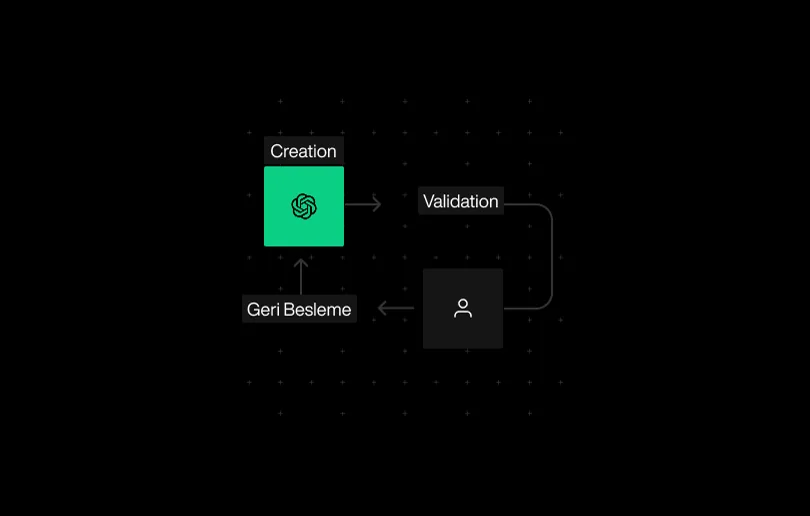
When the speed of artificial intelligence meets human judgment, the result is the Human-in-the-Loop (HITL) model. In fact, all of us already use this model without realizing it.
Having AI write a piece of text and then editing it in our own voice, refining an AI-generated image to fit the brand, or interpreting an automated report strategically are all part of the same loop. In this model, AI produces, while humans evaluate, improve and give direction.
The Facts Behind the Data
Intent data and AI are no longer the future of marketing; they are a necessity today. At this point, I’d like to share a few recent figures with you. RollWorks research reveals that 97 percent of B2B marketers see intent data as a competitive advantage. Half of the respondents use this data to identify new customer accounts and to align sales and marketing processes. The value of data shows in how much easier it makes decision-making. According to Sprinklr’s 2025 report, 78 percent of CMOs have actively integrated generative AI into their marketing processes. In these companies, average revenue growth is 10–15 percent, while return on investment approaches 20 percent. Most marketers say that, thanks to AI, they can now focus on more creative and strategic areas. Data shows us where to look; AI shows us how to get there.
Engagement Is an Outcome, Not a Goal
We are seeing the impact of this transformation in the field, too. By integrating intent data into its digital ad campaigns, Salesforce increased its return on investment by 271 percent and shortened its sales cycle by a third. With the Beauty AI Studio it set up for its Dove and Vaseline brands, Unilever sped up content production by 30 percent, cut customer service response times by 90 percent and doubled video completion rates. Starbucks runs personalized campaigns with its AI engine, Deep Brew. Marketing teams oversee the system and align its recommendations with the brand’s values. As a result, loyalty program membership grew by 13 percent in a single year to more than 34 million. Nike used data from its 170 million members to build a personal shopping assistant in just 21 days.
The entire process was carried out under human control, and brand consistency was preserved. These examples clearly show how collaboration between technology and intuition produces tangible results.
Summary and Sources
The HITL model, industry data and successful brand examples presented in this article are living proof of "The Intelligence Layer" philosophy. We have seen that what drives growth is the ability to use technology to seek answers to the right questions. Making sense of data instead of hoarding it, combining it with intuition and keeping people at the center of the process form the foundation of sustainable growth.
I’d also like to share some of the sources I drew on, which I think you may find useful:
• McKinsey Design Index 2023
• Sprinklr State of Marketing & AI Report 2025
• RollWorks Intent Data Insights 2024
• Salesforce AI-Driven Marketing ROI Study
• Unilever AI Studio Case Report 2024